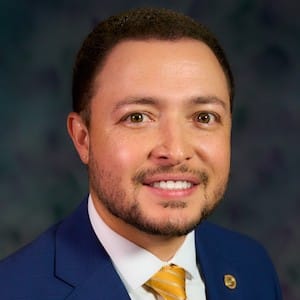
Welcome to Stop Requested, the podcast where we discuss everything transit.I’m your Co host Levi McCollum, Director of Operations at ETA Transit.And I’m your Co host, Christian Londano, senior customer success manager at ETA Transit.
0:20
Welcome back to stop requested Levi.How you doing?Hey Christian, I’m doing very well.How are you today?Doing great, just really excited.We have very special guest, I would say a legend in the transit industry, Mr. David Rachel who is a the former Executive Director of Qatar, the Center Area Transportation Authority in Pennsylvania and he’s the principal and owner of Delta Services Group that specializes in park transit and ADA operations.
0:53
How you doing David?I’m doing great.And thank you for joining us this morning.We’re very excited to learn about your career and, you know, talk about that extensive experience in different projects you worked on.So, Levi, how about we jump into, you know, learning more about David?
1:10
Absolutely.Let’s do it.So David, you’ve been in the industry for a while.One of the questions that we always like to start with on stop requested is how you got in the industry.For a lot of people, it’s not only your path.I’m curious what yours was.Mine was not a linear path.
1:26
I was finishing three years of Navy service after after college and I was looking for a job.And of the jobs that I looked at, it was a company called Mayflower.You may know them as a moving company, but they used to do contracted transportation and they were looking for managers for paratransit, which was this weird new on demand service for people who had disabilities and it sounded interesting, so I signed up with them.
1:58
That’s really interesting, David, and thank you for your service.My pleasure.So what?Were some of your earliest roles, What were some of those takeaways too from from those roles?You know, you, you start out, maybe I’m sure it’s not in a, you know, executive director type role.
2:16
You probably had some, some challenges along the way.What what did you learn from those early positions?Boy, I came in as a project manager for Mayflower, so I ran a couple different operations.The biggest one was in Philadelphia for SEPTA, and I learned that this is hard work.
2:36
The paratransit in particular is a very difficult service.Just the concept of scheduling and keeping people on track, it’s a lot of work.Can you tell us about your journey becoming Executive Director at CATA?
2:52
How did that process?Go Well, it was an accident, kind of like me coming into transit.I was working in consulting, which is really what I’ve been doing since 2000.When I left one of my positions.I decided I want to try consulting for a couple of years, and I ended up consulting for 25 years.
3:11
But I was working for the board of directors at CATA and State College.They’d recently formed, and they were looking to revisit their board governance and they wanted to talk a little bit about a strategic plan.And about a month into that project, the CEO of Cata resigned and the board chair asked me if I could stay around for six months and just kind of mind the store while they found a new CEO.
3:37
And two years and seven months later, I just finished that position this past Monday.Wow, so recently departed from Cata.You know, that had to be a surprise, right, To take on that role, and especially not when you’re, it sounds like you weren’t really expecting it and then to stay there for.
3:58
Nearly three years.What did you enjoy most about, you know, being in that executive director position there at Cata?Well, I I love the organization.I love the people.It was, it was an organization like a lot of transit systems that was still struggling after COVID to find their footing.
4:16
They’d lost a lot of ridership, they’d lost a lot of bus operators and mechanics, and they were still kind of struggling to to keep things on the road every day.And we took care of a few things initially.
4:32
And I talked with the board and the board asked if I’d be willing to stay a little bit longer to take care of some things that they just hadn’t gotten around to.And I said sure.They were flexible with me about some consulting projects that I had because I had contracts and I had obligations and they were willing to be to work with me and let me continue to do a little bit of both.
4:58
And that gave me the freedom to stay.And it was just wonderful.They’re a great group of people.We, we took a really hard look at the services that we had on the street and a realistic assessment of how many bus operators we thought we were going to have.
5:13
And we really redesigned a lot of the service and we had some fantastic people there who frankly just needed to have their creativity unleashed.And we, we did a major redesign of our bus routes.Cata is a strange little system.
5:31
It’s the third largest in Pennsylvania in terms of ridership for a single, a single site operating system.And even though it’s a town, the whole area has less than 100,000 people.We do this past year we did 5 million rides.
5:50
So it is a really high tempo little system.It serves the community and it serves the campus of Penn State University.So we have some areas of really high density and we were able to redesign a local express routes and get the timing so that we had buses arriving in some cases every 11 minutes during peak.
6:11
And then some of these are 60 foot articulated coaches and we were still struggling to be able to transport all the passengers.That give you some sense of the of the scale the operation.But we really redesigned services to focus the more on where people were, where they were traveling.
6:29
And we also took a hard look at some lower density areas outside of the community where we were running buses that people were not riding.And we realigned some of those services and replaced that service with micro transit, which was a much less expensive option and actually ended up providing better coverage for people at a lower cost than we were with running mostly empty buses. 05 million riders, there’s nothing to sneeze at that.
7:00
That’s quite a lot for a town of 100,000.Of course, you’ve got the university there, so that I imagine contributes pretty significantly to your ridership.I’m curious, did you all run your own micro transit service or is that something that you outsource to a third party?
7:16
Our all of our micro transit and paratransit services at CATA are contracted out.So we actually designed the service with a common fleet and a Common Core of drivers so that we could use the vehicles for either paratransit or micro transit, you know, depending on what the need was.
7:38
David, I, I want to now ask you a little bit more about some of the projects you worked on during your career and, and the innovations that came with them.So I want to start by asking what are some of the most exciting or impactful projects that you worked on during your career?
7:57
I would say the biggest one probably was in New Jersey Transit.I went to New Jersey Transit after being in the private sector.Think I had just figured out what paratransit was and a little bit about how to run it and New Jersey Transit was looking for somebody to implement their ADA paratransit program.
8:18
NJT didn’t run any paratransit.They were one of three big systems in the country that I know of that really didn’t have paratransit prior to the ADA, Los Angeles, New York and New Jersey Transit.So, you know, New Jersey Transit is a statewide Transit Authority.
8:37
There are 28 counties, I think, in New Jersey.So we had to figure out a way to create a paratransit network that shadowed the local fixed route bus system and provided service into New York City and provided a service into Philadelphia.
8:56
And they had a paratransit plan.But the person who developed the plan left New Jersey Transit right after she wrote it.And this was May of 1992 and service had to be on the street by January of 1993.
9:16
So we quickly put together an operating concept of of how to tackle a statewide service.We decided the service would be done in operating regions.We were going to contract out for service delivery.We were going to do the telephone calls to reserve trips in house and we set to work trying to get service on the street by that January, essentially seven months ahead.
9:43
And we did.We, we started a service in one small area, Mercer County, where the state capital is in Trenton.And then we implemented it from there over several years and got the service up and running. 6 operating regions.
9:59
I forget how big the service area is but it’s something like 3 or 4000 square miles.Was huge, very very challenging.Some super rural areas and some really dense urban areas, regional connections, just everything.
10:17
I could tell you stories about NJT forever, but that was really impactful because here we were creating a, a statewide paratransit network that connected people in ways that had never happened before.And it was really great.And we’d approached eligibility different from a lot of systems at the time that we looked at the requirements and the regulations.
10:39
And we just said, you know, there’s just no way you’re going to be able to have a paper application that’s going to be able to answer these questions.So we from the start decided to go with an in person assessment process and also recognize that was going to be hard.
10:57
So we thought, why don’t we partner with community agencies who work with these folks and have them help us with with the intake.So people would make reservations through us to go for an interview.And we had organizations like AR, CS and UC PS and different community based organizations actually did the interviews for us and the assessments for us.
11:24
Then they would send us the assessment reports and their only request was you guys have to make the decisions because if you say no to somebody, we don’t want to be the bad guys.So you have to be the bad guys.We said that’s fair.But we we had a really great partnership then with all these statewide agencies.
11:42
And then you know, one of the benefits of that was that we got buy in from them.They understood what paratransit was supposed to be and they understood that we wanted to make mainline accessible transit the primary choice.And the paratransit was for folks who really couldn’t use those services.
11:58
So that was kind of an unexpected, really great benefit.That had to be transformational and I have like 1000 questions that comes to my mind that I’m struggling to figure it out which one to ask.But you know, this is a few years after ADA became law 1991 if I’m not mistaken, correct?
12:19
Yeah, that’s correct.So there’s not a lot of experience, there’s not a lot of guidance and and then now you’re put in an ADA service for a whole state that didn’t have any part transit service before.So everything has to be new, right?
12:35
Like you, you’re dealing with all these different situations.Like you, you know, you have all types of disabilities.You have folks, you know, with Alzheimer’s and the drivers have to know that if they say like, oh, you don’t just drop me off here, you don’t do that because then now you’re going to lose that person and you know, they’re supposed to drop them off at their destination.
12:53
Like so many nuances with the complexity of part transit operations that when you first start, you don’t know about like, you know, this, this, this.So my first question before we we get to that is about demand, right?
13:09
How could, how did you project the demand or, or calculated how much service, how many vehicles do we need and how much do we have to put out there to be able to meet the needs, right?Because these people somehow are getting around, right?Like that.There’s no par transit right now.
13:24
People are driving them or they’re maybe I don’t know how they’re getting from point A to point B before the services.So talk to me a little bit more about how you projected the the demand and what was the response from the community.All these people calling and trying to get on this service they were excited about could.
13:41
Could you describe that moment?Sure, I, I should, but let me also point out something it it which is very important when I say we didn’t have any paratransit, that was New Jersey Transit didn’t have any paratransit.There were county based programs in I think all of New Jersey’s counties that were more traditional paratransit in the sense that they were like senior services and the and kind of employment based.
14:08
So they had a lot of restrictions.They provided some services, adult day care kind of services, but they they didn’t give you the flexibility that the ADA required, which is that you can go anywhere, anytime for any purpose.So those systems didn’t work very well for people who wanted to get to work, for example, or who had medical appointments that really needed to be there precise times.
14:32
That was what was new for people that that they had a service that was going to be reliable and that they could count on when they called to get a ride that we were going to have to say yes.And we use some of those county systems as just a ballpark guess of how much ridership we thought we would get for these different services.
14:53
And, you know, we bought vehicles and we, we planned an estimated and we assumed that service, which is going to continue to grow in the best, the best thing you can do.I mean, I, I, we’ve looked at a lot of ways of doing projections here, but paratransit demand projection is, is a pretty quirky science.
15:13
And the best thing you could do is to just simply look at what your trends have been, get feedback from your customers and try to be as responsive as you can.So we would, you know, buy vehicles in advance and, and look at our trends and try to let the system grow and be able to meet that demand.
15:32
It, it was challenging.It still is challenging for every system around the country.And and expensive so.Very expensive.Where are you charging fares from the get go?Or was it free at the beginning?No, it was, you know, one of the things that, believe it or not, made it easier for us is that we weren’t taking an existing paratransit program, which is what many transit systems did, and converting it to ADA.
16:01
We built the New Jersey Transit system literally based on the ADA requirements.So whatever the requirement was, that’s how we we build it and fares were one of it.New Jersey Transit has a a distance based fare system, which was kind of challenging for us.
16:23
And in fact, we work with the a software company.I don’t want to mention any companies by name, but it’s one that you would think of with the circus.They, they developed a program that used our itinerary planning system for bus routes to figure out if a person wants to go from A to B, how would they do that on the bus system and what would the fare be for that trip?
16:52
And then we would double that fare, and that was the paratransit fare.OK, So you pretty much didn’t just experiment with with things outside of the ADA, just, you know, read the law and each one of the things you needed to be compliant with.That’s how you operate the service from the get go and you stay within that 3/4 of a mile from the fixed route.
17:13
Like not everywhere and anywhere in the state of New Jersey, but just what was required.Is that what I’m understanding?Yeah, that’s exactly right.And again, we had the benefit that there were the county programs and the county programs were much broader.So customers really had a choice.
17:30
And what seemed to happen was that people who were taking very casual trips often stayed with the county because the county systems were usually cheaper.And if people had like medical needs or a long distance trip that was multi county or they were going to work and they needed to be sure they were going to be there on time, they would tend to use us.
17:54
So, so the, the response to the community, they were, they were very happy.I, I’m pretty sure it, it, it’s interesting because the, the work with paratransit is it’s very difficult.Like you’re caring with, you know, the most delicate constituents in a community, you have to do door to door.
18:12
They have all the special needs.So you have to have that training that the driver has to have that awareness to be able to provide that best care to each one of the riders.And yet, you know, people are still complaining, right?Like it’s share right system.Sometimes, especially now in some agencies, they struggle with that.
18:29
Like why are you picking up other people?Don’t you?You know, I paid $2.00 that you should take me directly.So, so, you know, sometimes people, they, they’re not as grateful for a service that is so heavily subsidized.But I would imagine when they had that transition from those very kind of, you know, basic Par Transit services to the service that you guys launched then, you know, there was a great response from the public back then.
18:56
Yes, for sure.The public was very appreciative of the service and it really enabled people to travel in ways that they they couldn’t travel before.And that created some headaches for us too.As you can imagine, a statewide bus system is interconnected.
19:12
So it was possible for you to go from New York City, which is way in the north of New Jersey, all the way down to Cape May, NJ, which is at the very southern tip on local buses.Yeah, you’d have to connect to, I think it was 3 or 4 different routes, and it would literally take you almost all day to do it.
19:33
But it was possible.And so because of that, we had the mirror, the fixed route system, and we had to make it possible for people to do the same thing on paratransit.But we took that really literally.And so we would do things like require transfers between different paratransit regions because, you know, the idea was you’d have to transfer between buses and it would take you a long time.
19:56
So we tried to apply the same standards to the paratransit system and that that sort of helped us manage some of those unusual requests.And, and it’s about access, right?Like, you know, once you deploy a system such as the one you’re describing, then then it’s providing access to those people like things that were not possible, they’re now possible.
20:17
Even if you know, you would not necessarily travel all the way from New York to, you know, the Moors Southern point of New Jersey every day, if you wanted to, if that’s something that you wanted to do, it was possible and before it was not.So you know that that’s just impressive.
20:34
And last question regarding that project, the way that it operates today, how how close is from what it was when you guys launched that service?I think the basic operating concept hasn’t changed, still operates in different regions.
20:54
I’m not as in close touch with those folks today as as I have been in the past, but they are experimenting a little bit with some on demand services, some TNC based services.I think it was mostly driven by cost and by lack of a bus operators.
21:11
The same challenges many systems are having, but the the core system still pretty much works the same way.That’s good to know.That’s legacy and and that’s impressive David and you see that experience I know have let you to also be involved with so many other experiences related to transit.
21:31
One of those was serving as a court appointed ADA expert in cities like Boston and LA.Could you speak a little bit about that experience?Sure.That was, that was some really interesting work.
21:47
The first one I had was in Boston, actually.I started out as a consultant to the plaintiffs in a class action lawsuit against the MBTA.And I have to tell you, it was a little bit uncomfortable as a transit guy working on the the plaintiff side.But they called and they said, hey, we’re looking for a transit expert.
22:06
And they talked to me about the case and it seemed clear that they had some legitimate points.And I’ve always tried to be not on one side or the other.I try to be, you know, what are the facts?What’s the reality?And it seemed like there were some things that needed to be fixed.
22:23
So we worked with folks in Boston.And with that case, there were a lot of allegations that the bus operators on the fixed route side and the elevators just weren’t working properly.So rather than kind of get into a he said, she said, we suggested to them, why don’t we do some research?
22:42
Why don’t we do a study?So we conducted 2 analysis projects.One was to hire an elevator expert and to do some elevator inspections to see what some of the issues were.And the other was to come up with a secret shopper program for the bus system where we we created a system.
23:04
I worked with a professor from University of Pennsylvania on the the kind of methodology and science behind it.But we came up with a system where we were sending teams of two people, person with a disability, either using a wheelchair or other mobility device, and an observer who would go out and ride the buses.
23:22
We came up with a quasi random sampling technique and over the period of about a month, they did more than 1000 random rides throughout the system and they evaluated every aspect of the ride.And we compiled that data and wrote a report for the plaintiffs and they presented it to the T management and to to the credit of the T’s management, and that was Dan Grabowskas, who was the CEO at the time.
23:51
They looked at the report and they looked at the data and they decided let’s stop wasting our time arguing about this case and let’s work on fixing the problems.So they went into a settlement and in that settlement, I then worked with the, with the master that was appointed by the court over a number of different years to, to make improvements there.
24:13
And that and the T is now a leader with accessibility.And in fact, they liked our, our our process of evaluating accessibility so much that they asked us to continue doing it even after the lawsuit was settled so that they would have, you know, additional data points of how well they were doing.
24:33
So that was that was an incredible experience doing that.I learned so much and actually worked with some folks with the Justice Department.And they were just finishing up a lawsuit that they had filed against D dot in Detroit.And in that case, they were also looking for an assessment of how the system was working.
24:55
And they wanted me to also be the the independent monitor of the settlement.So I did that in Detroit for about 5 or 6 years to get D dot to be fully ADA compliant as well.I can really appreciate your scientific approach it it’s very analytical and it sounds like you you want to follow the facts.
25:17
And I imagine that that all those experiences combined have helped you with your your new consulting business.Can you describe a little bit about you’re what you’re currently doing with Delta Services Group and how those prior experiences have informed you?
25:37
Yeah.Well, currently I’m pretty much consoled in all things related to ADA, whether it be fixed route or paratransit and frankly now even micro transit.A lot of the work that we’re doing has to do with embracing new technology and looking at how micro transit and paratransit can work together.
26:00
There are a lot of voices out there talking about how you can put all these services together in a single stream and have one software and kumbaya.We all get along and it’s just wonderful.But those of us who know paratransit understand it’s not that simple.
26:18
You can commingle services and, and you can use a single fleet provided you have the capacity, but your ADA paratransit passengers have to come first.You have to be sure you’re meeting the requirements, the, the federal requirements.
26:34
And then if you have extra capacity, you can do some micro transit service.And in a couple of projects I’ve worked on, I, I work with a colleague, Christian Kent, some of you, so our listeners may know him.We worked with a couple of different systems that we’re trying, some commingling and we learned a few valuable lessons there where you have to be really thoughtful about how you’re adding micro transit trips into the paratransit trips where you’re disrupting or you’re moving the paratransit trips from the time you promised the customer.
27:08
And that really is the big challenge.That’s, that’s an excellent answer, David.And you know, I appreciate the, the thought that you put into these projects and you know, understanding the nuances, right, Because often times it gets kind of swept under the rug.
27:26
This, this commingling term, as you mentioned, can make it seem very kumbaya.It can make, make it seem that everything is roses, but it is much harder, I think, in practice, as you just described.Can you describe some of those mistakes that you see some agencies make when they’re they’re trying to do commingling or even modernizing their paratransit?
27:50
Well, everybody’s concerned about cost and some of the things that that I’ve seen, one was just as I mentioned of adding paratransit trips and micro transit trips together and forgetting that you have to anchor those paratransit trips and and keep them within a certain range.
28:11
You can’t, you can’t change the promise time that you’ve given to the paratransit customers or you’re violating the federal regulations.That’s one of the big ones that’s often often underestimated.Another thing is the systems are looking to embrace micro transit and even TNC based services.
28:33
It’s tempting to encourage people to use TNCS instead of paratransit services and that can make a lot of sense in a lot of cases.I’ve worked with a couple systems.PSTA in Florida is a good example where that’s been quite successful.
28:51
It’s important also to keep in mind that some passengers can’t use the TNC based services or don’t want to.There seems to be a kind of a wall that you hit where some passengers are are willing to use an alternative, but some passengers don’t want that.
29:10
They want to stay on the paratransit service because of the vehicle needs or the training of the driver or they don’t like the idea of just some random car coming up to give them their ride.They want to see an agency vehicle pull up with a driver in uniform.
29:25
They they are looking for that assurance.And and that’s not just preference.It may be related to the person’s disability and what their needs are.So you have to be really thoughtful about programs where you’re shifting people in to these other alternative services.
29:41
And frankly, one of the other things I look at as a consultant is when we think about ADA paratransit, it’s supposed to be a service that is intended for people who can’t use the accessible fixed route network.And the people using paratransit have fairly significant needs.
29:59
And if you have a gigantic base of paratransit passengers who can easily shift over and use TNCS, that may suggest that you want to take a look at your eligibility process because maybe you’ve made passengers eligible for paratransit who may not actually need it.
30:18
So that’s another consideration to think about very fairpoint.Do you have any advice for our our listeners who maybe work at a transit agency and they’re planning some major changes, maybe an overhaul to their system, You know, that could be on the fixed route side, which also has the implications of the paratransit side, or it could just be their their paratransit service, maybe it’s their eligibility program.
30:43
What’s that major piece of advice?I think my big first piece of advice is we have to remember that accessible transit was not supposed to be paratransit.Accessible transit was supposed to be the buses and the trains and the subways and the light rail.That was supposed to be accessible, and that was supposed to be everybody’s first choice.
31:01
It’s the most inclusive way to provide public transportation, and it’s frankly what the folks who designed the ADA and came up with the regulations wanted.There was a lot of question about whether paratransit should even be included because we didn’t want to segregate folks with disabilities on these little buses and not have them ride with everybody else.
31:22
So we need to make sure that our fixed route network is accessible, is working, our drivers are trained and we’re as welcoming as possible.And when you’re looking at then paratransit, I would look very carefully at eligibility, make sure that you’re making an appropriate decision because as we said, paratransit is really expensive and we want to be sure we’re providing it to the people who need it and that we have the resources to do that.
31:48
So look at your eligibility process and include education in eligibility.And a lot of folks who come in looking for a paratransit, they’re not looking for a paratransit, they’re looking for a ride they need to get around.So if you teach them about all of the accessible mobility options in your system in addition to paratransit, then it may be that they want to use some of those other services and are not interested in paratransit for every trip.
32:15
So be flexible that way and whenever you’re designing your actual paratransit services, you know, think about being as efficient as possible, think about maximizing productivity, get as many shared rides as you can because that’s going to reduce your cost.And it is increasingly an interesting and attractive idea to look at flexible on demand micro transit type services that can operate in parallel with paratransit and are often cheaper per trip because they don’t have the restrictions that the ADA regulations place on paratransit service.
32:50
You can be more flexible in terms of what you offer passengers and many passengers are satisfied with that level of service and they’re happy not using paratransit.So it’s a mixed bag.Lots of things to consider.That, you know, that’s another thing is, is the condition of eligibility, right?
33:09
Like we didn’t speak about that a lot, but you know, you mentioned eligibility and that’s part of that.And it’s really making sure that the people that are using the service are the people that should.And to your point, when ADA became a law, a lot of transit agencies from the stations, from you know, the coaches that were using, they were not ADA compliant back then.
33:30
You talk about on board announcements, you have interior LED signs that actually you can read what is being announced for anybody that you know is hearing impair like all these things were not in place or agencies were just starting to put these things in place back then.
33:46
And maybe a lot of the agencies have more intake into the para transit just because the system wasn’t like fully compliant.But today I see most areas and most transit agencies meet all these compliance through other system from stations, from vehicles.
34:05
So even, you know, they, they should be more focused now on taking a look at that eligibility process and even, you know, seeing if there’s an opportunity to, to improve that process.So you again to to your point and, and kind of like emphasize that again, you have people riding part transit that should be riding part transit and not, you know, everybody jumps in part transit just because they’re looking for a ride.
34:33
I I completely agree and you’re 100% correct about that.Transit was terrible in terms of accessibility when the ADA was passed.I mean, there were no lifts on buses, nothing.I mean, there were some systems that were, were trying.NJ Transit frankly was one that really was trying, but the technology just wasn’t reliable.
34:53
It is completely changed now we have a fully accessible national transit fleet.It’s it’s remarkable the transformation that has happened.I mean, the ADA drove the redesign of transit coaches.They’re all low floor now.There’s no steps to crawl up it it.
35:10
So the whole network is accessible and we don’t do a very good job as an industry of letting people know about that.There are people now that with my consulting practice, I talked to to customers, I talked to even transit professionals who don’t realize how accessible our national transit network is.
35:30
And they don’t talk about that first.They just go right to paratransit.And we’re doing ourselves as an industry a huge disservice by not getting the word out about how easy it is to use the buses and the trains now.So I completely agree with you.Yeah, I think that that promotion of transit, we we definitely need to promote more transit services in general, right?
35:51
There’s people that for their trips that they need to take, just mobility, they don’t understand some of these options or, you know, there’s a lot of work that has been done with, you know, new fair technologies to make it, you know, where people can pay with anything they have on them.
36:08
So it’s easier like, you know, removing these barriers to people to access access to transit, but also promoting it.It’s so important if people are not aware and it seems that because public transit like it’s, it’s somehow, you know, government service, right?
36:25
Like it seems that we don’t try to promote it, right?Like because it’s heavily subsidized, like you’re not trying to sell transit.But I think we should do more of that, like in all the communities, do a better job communicating the value, not just in the part of transit side, but definitely the fixed route networks.So I want to ask you this question before we we, we’re getting ready to wrap up in our conversation.
36:46
But with all your experience and you’ve seen it almost, you know, cradle to Gray, Well, at least, you know, since the initial implementations of ADA strategies to what it is today.And you know, we talk about commingling trips, micro transit, all these different, you know, TNCS, technologies, things to reduce cost, be more innovative.
37:07
I want to hear about your predictions for ADA.It is specifically ADA.Based on what you’ve seen, what do you think is going to be happening over the next 5 to 10 years related to the ADA that you heard about or you think it’s going to be where the industry is going?
37:24
Wow, that’s a big question.I would say that we’re definitely going to see a lot of growth with on demand services and I think this is transit in general.I am a huge believer in micro transit for suburban and more rural areas where there there’s just no way to route a fixed route that is going to touch people the way on demand services can.
37:53
And if you have an area where you know your density is low on demand services are are the way to go and making those services fully accessible, then you are handling the kind of paratransit accessibility question at the same time.
38:12
So I think that’s going to be or should be a major goal of our our industry to embrace those services where they make sense.I think on the paratransit side of things, there’s new software that’s coming in and some of the software it was designed to be ride sharing kind of on demand type software and it’s been kind of rejiggered to work as paratransit software.
38:43
And I think that’s going to change things as well.People, people have come to expect the paratransit should work like Uber works, which is in some ways unrealistic, but in other ways it’s kind of good that is helping us to try to be more creative and and be more efficient.
39:01
And I think that a lot of those services coming in, whether they’re used in paratransit or they’re used at micro transit, it’s going to be a spectrum of services that passengers are offered.And the incentive to transit systems is if you can offer some kind of a lower cost micro transit service that satisfies the needs of your paratransit customers and those customers use that service, then you’re going to be able to meet the the passengers need at a lower cost.
39:29
So I think you’re going to see a lot more of that in the coming future.And then we’ll have self driving cars and and then the world will change all over again.But David, thank you so much for joining us today and sharing your insights with us and our listeners.
39:45
I just before we wrap up, I have a couple of key takeaways that I wanted to share with our audience based on our conversation.You let me know if I missed anything.But the first one that I have is that it’s important to get by in.The second is that it’s good to embrace technology, but be thoughtful in your approach and how it will impact writers.
40:06
Buses and subways should be accessible first that this fixed line should be made accessible, then you think about your prior transit service, and then finally educate your riders on your other services.They may not know what all you offer.Is that what you would say would be the key takeaways.
40:23
I would say that’s right on the money.The only thing I would add to that is that our buses and our subways and everything now mostly are accessible.The gap is that our passengers don’t know it.Well, David, how can our listeners get in touch with you?Maybe they want to reach out, connect with you.
40:40
How can they do so?Well, I may be crazy to do this, but I’ll offer my e-mail address whichissimplymynamedavidrishall@gmail.com is one of the best ways to reach me and we can take it from there.Excellent.Thank you again, David.
40:56
Really appreciate your time today and thank you to our listeners for tuning in.We’ll be back next Monday with another episode.Thanks.It’s been a great pleasure.Appreciate the opportunity.Thank you, David.

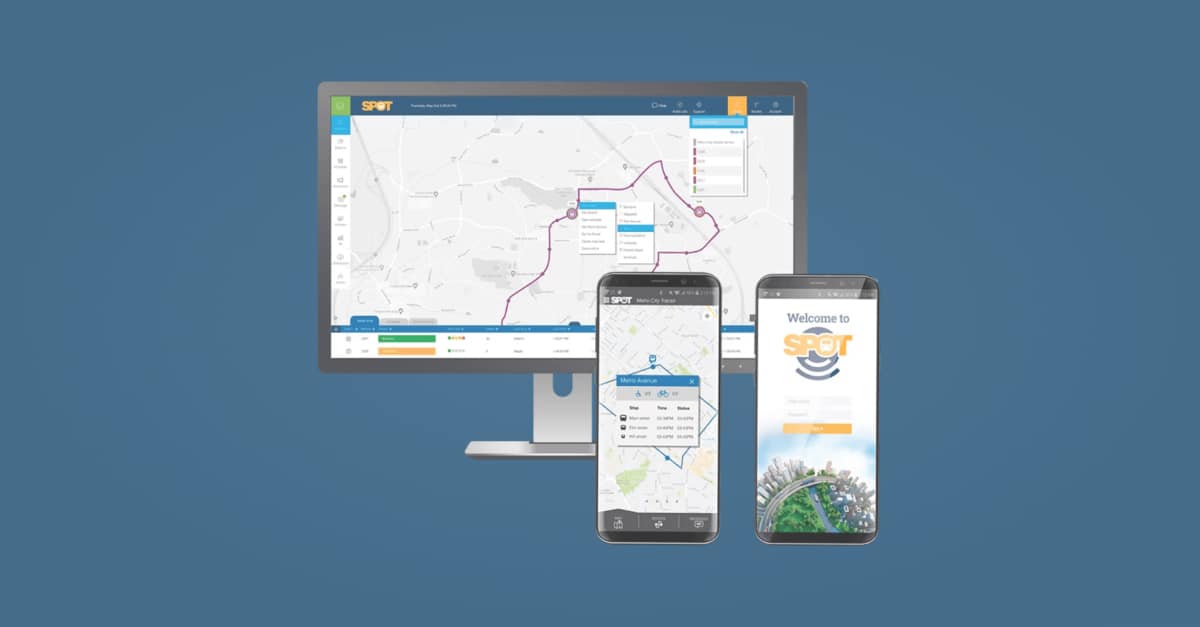
 SPOT: ETA’s Core Platform The SPOT™ ecosystem offers transit management solutions by providing a flexible, modular platform.
 SPOT: ETA’s Core Platform
  All Solutions
 CAD / AVL / GPS tracking
 Business intelligence
 Digital signs and kiosks
 Infotainment
 Automatic passenger counting
 Tally NTD Survey Software
 Tracking websites and apps
 Vehicle announcements
 All Integrations
 Demand-response and microtransit
 Fare collection
 Mobile video surveillance
 Pre-trip inspection
 Solar e-paper signage
 Vehicle health monitoring (AVM)
 Voice communication
 Transit
  All Industries
 Airport
 Campus
 Medical center
 Rail, streetcar & trolley
 Rental car
 Tourism & theme park
 Transit
 Case Studies
  Blog
Blog eBooks
 Wall of Love
 Careers
 Press
Press Events
 Support