Blogs, news, case studies, templates, podcasts and more; all right at your fingertips. Browse our comprehensive transit resources database to find information your agency needs to improve operations, grow your knowledge base, and expand your understanding of the industry at-large.
Designing for the Human Side of Transit with Mark Hughes
In this episode of Stop Requested, Levi McCollum and Christian Londono talk with Mark Hughes, founder and Principal Transit Experience Lead at Transit Experience Group and Chief Design Officer at Mark Hughes Creative. With a background in product design, digital experience, and customer experience, Mark brings a private sector design perspective into the transit industry. The conversation explores how riders experience transit through human interaction, why frontline employees shape trust in the system, and how training can better prepare operators for real world conditions. Mark also discusses wayfinding, communication during disruptions, rider confusion, and why customer experience is not separate from operations.
ETA Partners with Transdev to Improve Transit Technology at Texas State University
Boca Raton, FL. May 29, 2026. ETA announced today a new partnership with Transdev to bring its intelligent transit technology suite to Texas State University (TXST). Working alongside Transdev, the operator of TXST’s campus transit service, ETA will deliver CAD/AVL technology, rider information tools, onboard announcements, and integrated passenger counting capabilities across the university’s 49-bus fleet. Service is expected to launch in August 2026.
Indiana University Upgrades Shuttle Bus Technology with ETA
Boca Raton, FL. June 17, 2024. Indiana University (IU) has partnered with ETAs, a leader in innovative transit solutions, to enhance its campus shuttle bus service. This collaboration strengthens IU’s commitment to providing a diverse range of sustainable transportation options for students and staff. IU selected ETA after a rigorous evaluation process involving eight vendors.
Modernizing Fare Collection to Meet the Needs of Today’s Transit Riders
In this episode of Stop Requested, Levi McCollum and Christian Londono discuss the evolution of fare collection systems and their impact on transit agencies. From traditional cash-based methods to modern cashless technologies, they explore the challenges of legacy systems and the benefits of upgrading. Learn how improved farebox technology can reduce dwell times, streamline operations, enhance rider satisfaction, and optimize revenue collection. Whether you’re a transit professional or just curious about the future of public transportation, this episode offers valuable insights into how innovation is shaping the way we ride.

Forget text-to-speech for your on-board announcements, pre-recorded audio is better.
Turn up the volume on pre-recorded audio. By John Maglio, President ETAs Full disclosure: I’ve always disliked text-to-speech (TTS). It’s a wholly impersonal means of conveying critical information to passengers. From the sanitary, robotic pronunciation to the complete lack of support for local multi-lingual dialects. TTS is a poor way to connect with your riders and fails to measure up to the benefits of pre-recorded audio. I do understand the arguments for the use of TTS: Convenient: You can quickly input a message and it’ll be annunciated Real-time announcements: just type and go. Economical: No need to invest in high-capacity hard drives And truth be told, I’d rather have a text-to-speech announcement system as opposed to having nothing at all. It sure beats asking my drivers to take their eyes of the road to make a manual announcement over the loudspeaker. Safety, after all, is job one. But here’s the rub. Text-to-speech systems do nothing to build your agency’s brand or convey to riders the nuance of local life. Poor quality: No synthesized voice ever sounds a clear as genuine human words Added maintenance: It takes a lot of effort to tweak pronunciation engines to correctly enunciate words and phrases It’s part of my job to ride public transit systems, and I sometimes must stifle a laugh when I hear the text-to-speech audio botch the pronunciation of a stop. What is not funny is to see the passengers cringe at the error. It’s not hard to see that it bothers them, or to strain to understand what the message says. That’s a disconnect of brand, value, and sense of community, and ultimately that hurts the relationship between agency and customer. Pre-recorded audio enhances the agency’s relationship with its customers Your riders are just as important to the lifeblood of your operations as your agency is to their ability to get from points A to B. It’s a co-dependent partnership worthy of effort to ensure the highest possible transit experience. Adding value to the transit experience is straightforward and can be as simple as getting the pronunciation of key streets and landmarks correct. It’s a matter of local pride; it shows investment in the community. Pre-recorded audio is a solution to the shortfalls of text-to-speech systems, and it’s one I firmly believe provides transit agencies with greater options to engage customers and deliver a highly localized experience. Pre-recorded audio is more economical than you’ve been led to believe The knock on pre-recorded audio has long centered around two issues: Expensive: Audio generates large file sizes and requires high-capacity hard drives Long turnaround/production time: Audio recordings are manually processed and require coordination between voice talent and production studios The cost issue is never one to be taken lightly, however in the specific case of the file size of custom audio is rooted in decade-old thinking. The truth is that modern high-capacity hard drives are cheap. Pre-recorded is faster to implement that you may think The other argument, the turnaround time remains a valid concern. However, I would offer that it is not as large an obstacle as you may think. Agencies with an established relationship with an audio production facility often turn around high priority recordings by the next business day—sometimes sooner. When you think about it, how often do you really need to generate a real-time on-board message? The truth is that it’s a rare occurrence, often relating to a temporary traffic delay or situational emergency. By the next day, or even an hour later, that situation is no longer an issue. In most cases, your traveler information systems (i.e. bus-tracking websites, mobile apps, station and on-board signage), have already pushed out the notifications to your passengers and solved the immediate need for any TTS solution. Your typical use for text-to-speech is for long-standing purposes. Permanent stops, or repetitive alerts. Any changes to routes or stations is going to come with a significant amount of planning and forethought, so why not make the effort to do it right? I’ve been in the transit space since the early aughts. In all my time delivering transit technology to agencies across the country, I am hard pressed to recall many instances that truly merited real-time text to speech capabilities. With the right partnership between agency, recording studio, and thoughtful selection of local talent, custom audio production can easily be turned same day. Use pre-recorded audio to span geographic and ethnic boundaries Pre-recorded audio provides a chance to truly deliver precisely the tone and personality you seek to strike when communicating with your passengers. Barriers exclusive to TTS engines—gender, dialect, multilingual, emotion—all disappear with custom recorded audio. Recently, we implemented a custom-audio solution for South Florida’s Tri-Rail system which provided not one, but three distinct custom recordings—English, Spanish, and Creole—to better appeal to regular customers and tourists, alike. The customer chose his vocal talents, directed the proper enunciation, and approved the final audio before deployment; a process that proved to be very popular with their riders, visitors to the region, and employees alike. But what about voice talent? What if the person who recorded your initial audio moves or is no longer available? It’s not an unreasonable question, and a persistent challenge to maintaining a consistent audio library. In the nearly 20 years that I’ve advocated custom audio, this issue has cropped up from time to time. Our solution to this issue has been to re-record all audio for our transit customers at no additional charge. It’s not a sales pitch, nor is it a questionable business decision—not if maintaining the dedication to providing the best available product for our clients is the end goal. Lifetime recording is factored into the initial budget, and truthfully, we plan on changing out audio every couple of years as routes are added, dropped, and altered. Still, delivering the highest quality experience for passengers is the driving factor behind the decision, and when quality of engagement and an enhanced ridership experience is the goal, it’s worth it to us to provide this level of service. Isn’t custom audio more expensive? The answer truly depends on how one views the cost of a product or service. There’s the up-front cost of doing something, and then there’s the long-term cost; there’s the cost of having something done right, and the cost of having to repeatedly redo something because the effort to quality was sacrificed in favor of a lower initial investment. What is the cost of having 100 audio files produced correctly over the span of a day or two, versus the cost of having to pay an employee to manually adjust and tweak the pronunciation of 100 text-to-speech files? How much time does that take when you factor in employee costs and lost productivity toward other critical job functions? Consider a more real-world analogy: Have you ever bought the cheaper paper towels because you wanted to cut costs at the grocery store? Have you noticed that those cheaper towels weren’t as absorbent and you used twice as many to clean up that glass of spilled milk—or that because of the cheaper towels it took twice as long to clean up the mess? Is the up-front cheaper cost really a savings if it takes more time to complete, or results in a less efficient solution? Pre-recorded audio delivers on its potential. Pre-recorded audio delivers a better end-product in terms of clarity, quality, and options to transit agencies looking to build long-term brand value and deliver a heightened ridership experience. Many of the factors that initially contributed to the rise of TTS (cost, turnaround) simple aren’t as relevant as they once were. It’s not that text-to-speech is a bad solution, it’s just that it’s not as good a solution as custom audio. When the value impact of its production are factored in, including the boost to rider satisfaction and improved overall experience, doesn’t it make sense to give pre-recorded audio another listen? — For a demonstration of ETA’s SPOT® Intelligent Transit System, please click here or call 1-800-382-0917.
What It Takes to Lead a Transit Agency with Frank White III
In this episode of Stop Requested, Levi McCollum and Christian Londono talk with Frank White III, former CEO of the Kansas City Area Transportation Authority and founder and managing partner of Praxis Advisors Group. Frank reflects on leading KCATA through workforce shortages, funding pressures, regional coordination, and the return of fares after years of fare-free service. The conversation explores why transit leaders have to get the basics right before pursuing bigger ambitions, how data and transparency can help navigate difficult decisions, and why transit agencies should have a seat at the table in economic development and regional planning. Frank also discusses the realities of the transit CEO role, KCATA’s work in transit-oriented development, and how he is applying those lessons through Praxis Advisors Group.

Make Every Rider Count: Smarter Automated Passenger Counter Solutions with ETA & Xovis
We hear it all the time from transit leaders: We have APCs, but we can’t trust the counts.”
Designing Safer Streets for Walking, Biking, and Transit with Dr. Nick Ferenchak
In this episode of Stop Requested, Levi McCollum and Cristian Londono talk with Dr. Nick Ferenchak, Center Director for the Center for Pedestrian and Bicyclist Safety, Chair of the TRB Pedestrian Committee, and Associate Professor at the University of New Mexico. Nick explains why relying only on crash data misses many of the most dangerous corridors and how “latent demand” can help identify streets that are unsafe precisely because people avoid them. The conversation covers proactive tools like pedestrian level of traffic stress, the equity implications of unsafe infrastructure, and why arterials require more than incremental fixes. Nick also shares findings from Albuquerque’s BRT corridor, including major reductions in serious injuries and fatalities, and what it will take to design streets that work for walking, biking, and transit.
ETA Strengthens Customer Focus with Appointment of Christian G. Londono as Senior Customer Success Manager
Boca Raton, FL. May 21, 2024. ETA, a leader in innovative transit technology solutions, welcomes Christian G. Londono as its new Senior Customer Success Manager. This appointment underscores ETA’s unwavering commitment to exceptional customer service for public transportation agencies across the country.
Moving Austin Beyond the Commute with Dottie Watkins
In this episode of Stop Requested, Levi McCollum and Christian Londono talk with Dottie Watkins, President and CEO of CapMetro in Austin, Texas. Dottie began at CapMetro as a part-time bus operator more than three decades ago and now leads the agency through a period of service expansion and long-term investment. The conversation explores how changing travel patterns are reshaping Austin’s transit network, from more local and crosstown service to new Rapid bus routes. Dottie also discusses Transit Plan 2035, Project Connect, supporting frontline employees, and balancing today’s service with the work of building a stronger regional transit system for the future.

How CAD/AVL Technology Is Powering the Future of Transit Operations
Computer-Aided Dispatch Automatic Vehicle Location (CAD/AVL) is the backbone of modern transit management. The solution provides the tools to deliver safer, more reliable, and more efficient service. It powers digital tools to assign and manage vehicles, replacing traditional radio-based dispatch with a data-driven future-facing solution.
Transit Technology Vendors: The Days of Closed Systems Are Over
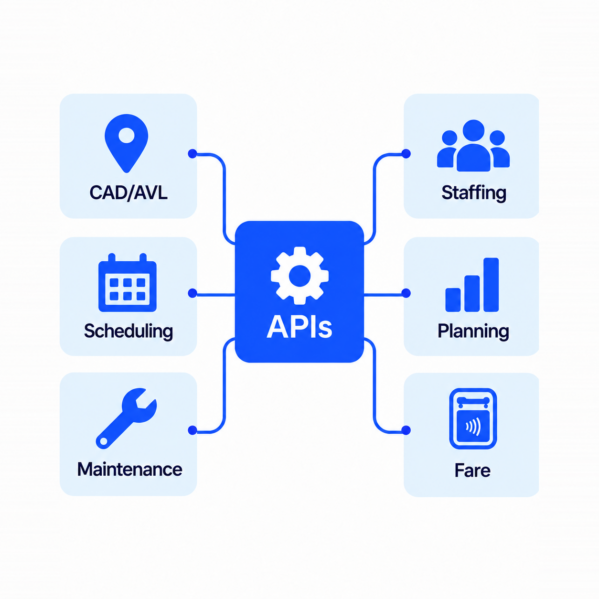
I’ve spent much of my career in this industry, and I’m still surprised by the state of transit technology APIs. Some provide limited functionality, some companies don’t offer APIs at all, and others have APIs but won’t make them available to their customers. For an industry that talks so much about integration and interoperability, we have a lot of work to do.
Looking for a specific type of resource?

Blog
ETA created content on topics of interest across the transit industry. Expert insight, opinion pieces, and the latest in transit innovation.

Podcast
Conversations with the foremost experts across the transit industry to discuss lessons learned, technological innovation, community needs, and so much more.

Case Studies
See the results ETA’s clients have received through replacing legacy CAD/AVL systems, installing new functionality, and doing it all without full hardware replacements.

Press
New awarded contracts and the launch of innovative technologies are just the start of the latest ETA news.

Glossary
From general transit feed specification (GTFS) to ghost bus, the ETA curated glossary is a reference to better understand industry terminology.
Ready to see our Unified Operational Health software on your routes?
Whether your agency is modernizing an existing system, improving rider information, strengthening reporting, or working through a more connected operational approach, ETA can help make the next step clearer.