
Blogs, news, case studies, templates, podcasts and more; all right at your fingertips. Browse our comprehensive transit resources database to find information your agency needs to improve operations, grow your knowledge base, and expand your understanding of the industry at-large.

Part II: Marketing transit on the cheap.
We’re continuing our look at what local public transit agencies can do to market the technological investments they’ve made in their operations. If you haven’t done so yet, take a few minutes to Read part 1: Changing the perception about public transit to get some background information about the challenges public transit operations face when promoting their services. Part two deals with specific tactics that can be employed—even on the tightest of budgets. Skinny budget tactics Tactics, in support of a defined strategy, are the specific efforts used to perform on strategic objectives. This does require a set budget—both a comprehensive number, as well as specific allocations to each initiative. How you break down these numbers is largely due to the priority and expected impact of each within the overarching strategy. How are transit agencies marketing themselves? According to ETA’s 2016 transit agency survey: 1% of agencies use vehicle/station signage 6% of agencies use print advertising 6% of agencies use social media 8% use radio 4% use television 7% use billboards Except for vehicle/station signage and social media, these media channels are all high-dollar expenses and might not be the best use of limited resources for all situations—especially for those agencies with less than $30,000 in their marketing coffers. What other options are there? Social media Social media is an extremely cost-efficient way to interact with the public—both riders and non-riders. With so many available social media options, it’s important to know which ones are most likely to be used by your audience. This becomes especially important when considering the time involvement necessary to maintain a social media presence. Use it to conduct surveys and polls, communicate service disruptions, provide insights into community events, or even use it to engage followers with fun facts, trivia, memes, and other ‘sharable’ information that is likely to increase the perception of your agency within your market. Use paid placement to reach potential new customers within your service area. Social media platforms, such as Facebook and Instagram, have powerful—yet easy to use—demographic targeting capabilities that allow you to zero in on specific geographic, ethnographic, and economic considerations and reach precisely the type of individuals or groups who would be a good fit for public transit. What’s more is that these paid placement tools are extremely cost-effective, with $50-$100 easily placing your message on thousands of newsfeeds over a period of weeks. Leverage available space The no-brainer in marketing tactics is to utilize the open space on-board vehicles and at-stations to provide important marketing messaging. The good news is that 73.1 percent of agencies do this already, so the question is ‘what gives’ for the remaining 26.9 percent who aren’t using this space? It’s the lowest-hanging fruit in the marketing landscape and should be exploited to help target more people. As vehicles travel through town, a solid messaging campaign can bring awareness to passers-by on the streets and other vehicles on the roadways; new, untapped customers who may be searching for a way to simplify their transit needs for financial, lifestyle, convenience, or environmental reasons. Granted, 82.5 percent of agencies already use on-board space in a revenue-generating capacity, so perhaps the use of these opportunities is limited more by inventory availability that lack of desire to extend your marketing message. But… …you can extend your inventory by investing in on-board digital infotainment systems, something only 5 percent of agencies have embraced. It’s a relatively affordable expense to drastically increase your available inventory to advertisers by an order of magnitude, plus enhance your agency’s promotional efforts and brand value by mixing in specific, graphic- and video-rich promotions to run at set schedules. It’s not a bad idea, especially if you can leverage it as part of a technology procurement budget. Plus, 76.9 percent of riders want on-board infotainment systems according to our 2017 Transit Survey, so it’s a path to greater revenue, marketing reach, and improved ridership experience—sounds like a can’t-lose proposition. Marketing to existing customers Word-of-mouth (WOM) is a powerful (and free) means of getting the word out about new service improvements and ridership benefits. Take advantage of people who are already a fan of your agency and encourage them to spread the good word. In the Journal of Public Transportation article, An Evaluation of the Role of Marketing in Public Transit Organizations, word-of-mouth is the primary marketing option for a whopping 83 percent of agencies. WOM influences up to 50% of all purchasing decisions WOM generates more than twice the sales of paid advertising WOM influences every stage of a customer’s journey WOM can increase a market share by as much as 10% But… WOM is the most disruptive to consumer decisions WOM can vary wildly in its effectiveness There is a danger in only marketing to your current customers. It may be the easiest audience to reach, but you’re also at the mercy of their perception of you and your service. While referrals can be a powerful marketing tool (according to Nielsen Global Trust in Advertising Survey a whopping 92 percent of people trust the recommendation of a friend), you also sacrifice control over the message and you can find yourself at the mercy of the mood and perception of a specific messenger. If that individual is unhappy with your service, then the message is 50 percent more likely to be shared than a positive interaction. This means you need sure that the message you’re sending aligns with what your service can deliver. Media partnerships and sponsorships Be sure to engage local media and provide them with press releases and information about new services, improvements, detours, and special interest stories about your employees and riders. Local media is almost always starved for content—especially feature pieces—and can easily turn your news tip into an article or video clip in their pages, on their nightly broadcast, or on their websites. These opportunities provide a valuable means of getting the word out to the community and help to introduce your services to potential customers who may not have given public transit a second look. A savvy marketing person may even be able to leverage a news feature in trade for on-vehicle promotion for a local event or initiative that is sponsored by/close to the heart of the media outlet. This quid-pro-quo arrangement can further enhance the perceived standing of your agency within the community and result in both corporate and non-profit engagement down the road, as civic-minded entities look to partner with other area resources. Time is a resource As a final consideration, be sure to include the valuable resource of ‘time’ when choosing which tactic to implement. Labor-intensive projects—such as newsletters—can take dozens of man hours spread across the entirety of your organization to produce. These costs are often not considered when determining budget, and while ‘hidden’ from the balance sheet, the impacts of these efforts do extend to the other functions of your operations as people must dedicate time from core functions to write articles, print, fold, and address mailings, etc. Weigh the use and involvement of internal personnel carefully when determining if a tactic is worthwhile. Look for marketing solutions that can be ‘scheduled’ over extended periods or whose time expense require an up-front effort. For example: Instead of making social media posts or sending emails every day, use a management tool like Hootsuite or MailChimp so schedule all posts for the month (or quarter, or year). A couple of hours spent to draft and schedule all efforts is going to pay off in the long run as it’s easier to set aside a few hours once a month on a given day, than it is to find half an hour every day to draft a post. If you have your strategy and timeline mapped out, this should be a very easy, and straightforward production process. Plus, both options have free plans that lets you manage up a certain number of channels or contacts at no cost—for the budget-sensitive agency, that’s an effortless way to stretch the bottom line. Develop any print or direct mail campaigns at once. Not only can you provide the files in advance to media outlets and mail houses up-front, you can schedule specific drops to coincide with your strategic timeline. Plus, printing these efforts at once (called a ‘gang-run’) can significantly reduce your printing expense. Be mindful of the hidden resources required for any marketing effort and include those as part of your budget. The time of your staff and key stakeholders may not always show up on your balance sheet, but they can impact your operations in a way that undermines the very message and value you wish to communicate as a benefit. Final word Both quantitatively and anecdotally we understand that there are certain perceptions that surround public transit that aren’t entirely positive. As an industry, we can either accept these broad generalizations and choose to live with them, or we can opt to change the discussion and work to provide a different narrative which highlights the importance of public transit. The heavy lifting is being done by organizations like APTA on a national level, and that’s good for policy and the funding of grants and infrastructure project. But what is also needed is engagement on the local level, and in an era where agencies are struggling simply to keep their operations running, the marketing and budgets required to encourage greater use and advocacy is incredibly scarce. Transit agencies are continuing a trend of investing in modern technologies to improve the quality of their service. It is critical that the benefits of these investments are communicated communities they serve. These efforts become increasingly important in changing the dialog and perceptions surrounding public transit and its related experience—especially if gains in ridership or growth in service area are required. Despite low levels of funding, transit agencies aren’t without a voice in determining when and how to engage with their communities and riders. While an influx of funding in support of marketing efforts isn’t likely to be forthcoming, an agency doesn’t have to take a passive role in advocating for its existence and benefit to its passengers. There are low-cost, high-impact solutions available that—with a bit of foresight and planning—can be of immense value to the idea that public transit isn’t necessarily like the cliched ideas that seem to keep its reputation stuck in the past. —— Works Cited Bierman, M. (2015, 9 5). Intelligent technology will change how we use mass transit. Retrieved from www.miamiherald.com: http://www.miamiherald.com/news/business/biz-monday/article34127022.html Binet, L. (2009, February 2). Marketing in a Recession: 10 Things to Remember. Retrieved from www.adweek.com: http://www.adweek.com/brand-marketing/marketing-recession-10-things-remember-98256/ Brady, S. (2017). What Percent of Revenue Do Publicly Traded Companies Spend on Marketing and Sales? Retrieved from www.vtldesign.com: https://vtldesign.com/digital-marketing/content-marketing-strategy/percent-of-revenue-spent-on-marketing-sales/ Federal Transit Administration. (2018). Budget – US Department of Transportation. Retrieved from cms.dot.gov: https://cms.dot.gov/sites/dot.gov/files/…/budget/…/fy-2018-cj-budget-final52417.pdf Howard, M. R. (2018, 2 27). Yesterday’s Solutions for Florida’s Transportation Problems. Retrieved from www.floridatrend.com: http://www.floridatrend.com/article/24004/yesterdays-solutions-for-floridas-transportation-problems Joseph Cronin, J., & Roscoe Hightower, J. (2004). An Evaluation of the Role of Marketing in Public Transit Organizations. Journal of Public Transportation, 23-26, 32-34. Johnson, S. (2017, May 30). Transit Fares Only Partially Cover Public Transportation Costs. Retrieved from www.govtech.com: http://www.govtech.com/fs/Transit-Fares-Only-Partially-Cover-Public-Transportation-Costs.html Marketing Charts. (2013, 4 15). Bad Customer Service Interactions More Likely to be Shared Than Good Ones. Retrieved from www.marketingcharts.com: https://www.marketingcharts.com/digital-28628 Results. (2018, February). Retrieved from www.cmosurvey.org: https://cmosurvey.org/results/february-2018/ The Nielsen Company. (2012, 4 10). Global trust in advertising and brand messages. Retrieved from www.nielsen.com: http://www.nielsen.com/us/en/insights/reports/2012/global-trust-in-advertising-and-brand-messages.html Wikipedia. (2018, February 10). Farebox Recovery Ratio. Retrieved from www.wikipedia.com: https://en.wikipedia.org/wiki/Farebox_recovery_ratio#cite_note-:11-28
Joel Rey, Benesch’s Transit Services Director, Reveals the People, Projects, and Purpose Fueling His Success (Replay)
In this episode of Stop Requested, hosts Levi McCollum and Christian Londono sit down with Joel Rey, Director of Transit Services and Principal Associate at Benesch, to explore his 36-year journey in transit planning and consulting. Joel shares how a single university course sparked his passion for transit, leading to a career that has shaped mobility across Florida and beyond. From launching new transit systems from the ground up to navigating mergers and fostering a culture of mentorship, Joel offers candid insights into the challenges and triumphs of the industry. The conversation unfolds as Joel reflects on the evolution of transit planning, describing how his early hands-on research experiences grew into leading large-scale projects. He recounts key lessons from implementing transformative transit services such as LakeXpress and the SunRunner BRT, highlighting the importance of balancing community aspirations with financial realities and the critical role of stakeholder education. The discussion then turns to the impact of emerging technologies like microtransit, autonomous vehicles, and AI, and how these innovations are poised to disrupt and enhance the future of public transportation. Joel also shares practical advice for young professionals entering the field, emphasizing the value of soft skills, mentorship, and perseverance, and underscores that meaningful impact in transit often takes time and a willingness to engage with a broad range of projects and people.
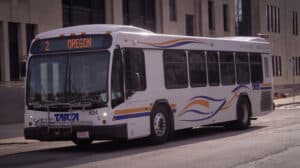
TARTA Transforms Transit Operations with ETA’s Integrated System
TARTA partners with ETA to streamline communication, improve efficiency, and deliver a more reliable transit experience for Lucas County riders.

Staff Engagement: Turn staff doubters into doers
Staff engagement is a critical, yet often overlooked component to new system adoption. As advanced and capable as the current generation of intelligent transit technology is, its performance will always be hampered by incorrect or inconsistent use. For all the time and resources spent in securing these solutions, it’s important to also invest in those people charged with using the system most frequently. A staff that sees technology as a benefit to their responsibilities, and not an obstacle, will outperform those who cannot make the association between technology and performance.
Bridging Transit Planning and Operations in Miami-Dade with Linda Morris (Replay)
In this replay of Stop Requested, Levi McCollum and Christian Londono revisit their conversation with Linda Morris, Chief of Service Planning and Scheduling at Miami-Dade County, as part of the Miami-Dade series.
Mass Transit Magazine Editor-in-Chief, Megan Perrero, on the Power of Transit Storytelling (Replay)
This week, Stop Requested replays our conversation with Megan Perrero, Editor-in-Chief of Mass Transit Magazine. Levi McCollum and Christian Londono revisit a discussion about how transit stories are reported and how coverage shapes agency credibility and rider understanding. Megan reflects on how her experience as a daily Chicago rider informed her journalism, the role of trade publications in the industry, and why transparency and clear communication matter for public buy-in. The episode also covers sector trends, the 40 Under 40 program, and advice for new journalists. If you missed it the first time, this episode offers a useful perspective on the connection between media, messaging, and public transit.

E-paper displays are ready for prime-time transit
The e-paper solution has emerged in the transit space as a happy medium between the old-school LED signs and the colorful, yet expensive HD LCD screens.
Matching Transit Service to Real Needs with Hunter Abel
In this episode of Stop Requested, Levi McCollum and Christian Londono talk with Hunter Abel, Project Manager and Transit Lead at Modern Mobility Partners. Hunter shares how his experience at LeeTran, MARTA, and now in consulting has shaped the way he approaches transit planning and project delivery. The conversation explores why plans often stall between planning and implementation, how agencies can define clearer goals, and why public input should focus on how people actually travel rather than which mode looks most appealing. Hunter also discusses data, tradeoffs, post-COVID service changes, and the value consultants can bring when agencies need additional capacity or a fresh perspective.
AI and the Future of Public Transit with Stephen Kuban
In this episode of Stop Requested, Levi McCollum and Christian Londono talk with Stephen Kuban, President and CEO of Kuban Transit Solutions, about how AI is actively changing the way transit agencies plan, decide, and operate. Stephen explains why AI is more than automation, how it supports better strategic thinking, and how agencies can use it to do more with limited resources while staying focused on outcomes. Stephen also shares how he is working directly with transit agencies through hands-on AI workshops and advisory programs, helping leaders move from experimentation to real-world application. Listeners interested in learning more about his AI pilot program and upcoming engagements can visit: https://kubantransit.com/ai-pilot
ETA completes 34 bus CAD/AVL project with University of Southern California in just three weeks
Boca Raton, FL. August 15, 2023. ETA, a leading provider of advanced transit technology solutions, is thrilled to announce that it has been awarded a CAD/AVL project with the esteemed University of Southern California (USC).

E-paper displays are ready for prime-time transit
New sign technology is poised to remake transit stop communication

3 key preparations to consider before autonomous transit arrives.
Autonomous vehicles are more of a novelty at this point, available in a few select areas. However, 52 percent anticipate that within 3-5 years, they’ll be in the market. That’s not a long time to develop, test, and procure solutions to satisfy the ancillary considerations related to self-driving vehicles.
Looking for a specific type of resource?

Blog
ETA created content on topics of interest across the transit industry. Expert insight, opinion pieces, and the latest in transit innovation.

Podcast
Conversations with the foremost experts across the transit industry to discuss lessons learned, technological innovation, community needs, and so much more.

Case Studies
See the results ETA’s clients have received through replacing legacy CAD/AVL systems, installing new functionality, and doing it all without full hardware replacements.

Press
New awarded contracts and the launch of innovative technologies are just the start of the latest ETA news.

Glossary
From general transit feed specification (GTFS) to ghost bus, the ETA curated glossary is a reference to better understand industry terminology.
Ready to see our Unified Operational Health software on your routes?
Whether your agency is modernizing an existing system, improving rider information, strengthening reporting, or working through a more connected operational approach, ETA can help make the next step clearer.